When handcraft meets high tech: how Legacy Effects elevates its work with Bambu Lab 3D printers
How a Hollywood FX pioneer uses Bambu Lab printers to bridge traditional craftsmanship with modern filmmaking



In the old days, special effects in movies were primarily associated with workshops filled with clay, latex, and polyurethane foams, where physical objects were created over weeks by the hands of highly specialized artists.
Over time, many of these techniques were gradually replaced by computer-generated imagery (CGI), but practical effects - as well as costumes and makeup - continued to rely heavily on manual craftsmanship.
However, over the past few years it has become increasingly clear that a new tool has entered the game, quietly changing the rules of film production.
3D printing has ceased to be a technological curiosity and has become a real component of the practical effects pipeline - from the very first sketch to elements that actually end up in front of the camera.
In an industry where time matters, the ability to move quickly from a digital design to a physical object has proven to be more than just an efficiency boost. 3D printing has begun to act as a bridge between traditional craftsmanship and modern engineering, allowing special effects teams to experiment faster, cheaper, and more boldly.
Importantly, this is not limited to prototypes or “behind-the-scenes” elements. Increasingly, these are parts that must withstand the harsh conditions of a film set, meet strict mechanical requirements, and at the same time look flawless in close-ups shot with high-resolution cameras.
It is precisely at this point that questions about the limits of the technology arise. What requirements must a 3D printer meet to be suitable for work on large film productions?
Is material versatility enough, or do reliability, speed, and consistent quality turn out to be the decisive factors?
And finally, what does the moment look like when a small desktop 3D printer begins to replace large industrial systems?
The story of 3D printing in special effects is one of very concrete needs and decisions made under time pressure. It is also about how a technology that was meant to “just help” has begun to redefine the way cinematic magic is created.
Legacy Effects
Legacy Effects is a renowned special effects company that brings some of Hollywood’s most legendary creatures, characters, and practical effects to life. Officially established in 2009 as a continuation of Stan Winston’s studio, which dates back to 1973, Legacy Effects has grown into an industry leader in practical effects for film production.
It was responsible for such a feature films like Terminator, Jurasic Park, Avatar, Iron Man (2-3), The Avengers, RoboCop, or Pacific Rim.
The company also contributed character design for films including Godzilla, The Amazing Spider-Man, The Hunger Games and afromentioned The Avangers and Avatar.
The company specializes in creating everything from static or full animatronic puppets to prosthetic creature makeups to half-mechanized creature/armor suits for on-screen use.
With a team ranging between 60 and 200 employees depending on project scale, Legacy Effects continuously pushes the boundaries of creativity and technical excellence in the film industry.
The Challenge - speed, quality and more!


As a leading film special effects company, Legacy Effects began exploring the potential of 3D printing long time ago. While the inherent flexibility of 3D printing technology has been immensely beneficial, flexibility alone is insufficient for their specific applications.
Critical factors such as printing speed, the ability to process engineering-grade materials, and a high print success rate are equally essential.
Ideally, the printer should not only meet these performance requirements but also be more cost-effective than competing models.
Legacy Effects needs to produce a wide variety of props - from foreground and background pieces to full-scale prototypes. To accommodate these diverse requirements, they require highly versatile printers.
For high-temperature applications, they demand engineering materials with excellent weather resistance; for situations where mechanical strength is crucial, they require materials that offer exceptional durability; and for precision tasks, they rely on refined aesthetic materials and superior print quality.
The older, slower FFF printers limited to PLA have proven inadequate for these demanding needs. The ability of Bambu machines to print the entire spectrum of filaments from TPU to PLA to PACF and smoothly transition between them due to Bambu Studio slicer profiles has made them the default machine for any of Legacy Effects’ needs.
The integration of Bambu Lab 3D printers


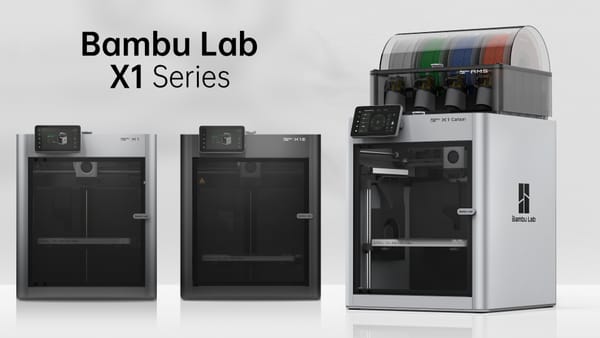
Approximately two and a half years ago, Legacy Effects integrated Bambu Lab 3D printers into its production workflow. The company currently operates four X1C printers and one A1 printer, with each X1C paired with an AMS module for enhanced performance.
These printers have been instrumental in streamlining both rapid prototyping and the production of final, camera-ready components.
Specifically, the printers are used as follows:
- 30% for prototyping - refining designs that are later produced using other manufacturing technologies.
- 30% for functional detailed parts - producing high-resolution components that require minimal post-processing and are directly used on set.
- 20% for detailed parts to be molded - molding rigid highly detailed prints allows them to be cast out of soft silicones, urethanes, and foam where applicable, such as prosthetic makeups and flexible armors.
- 20% for end-use mechanical parts - fabricating durable components for practical effects.
On average, Legacy Effects runs about 70-100 prints per month, achieving significant improvements in both print quality and turnaround time.
Production impact and benefits


The adoption of Bambu 3D printing technology has had a transformative impact on Legacy Effects’ production workflow.
Key benefits include:
- Enhanced Speed and Efficiency: The accelerated printing process has dramatically reduced prototyping lead times, enabling faster design iterations. Where previous FDM printing methods took 1-3 days for medium-sized models, Bambu printers have reduced production time to within an 8-hour workday, allowing the company to clear production queues more efficiently and iterate designs rapidly.
- Improved Print Quality: With higher resolution outputs, many printed parts now require little to no post-processing, reducing reliance on additional printing technologies such as SLA for surface quality while maintaining near perfect part dimensions and tolerance.
- Cost Savings: The cost of filament has been reduced significantly—from approximately $29 per kilogram to $14 per kilogram—while resin consumption has also decreased, contributing to overall lower production costs.
- Streamlined Workflow: Integration with Bambu Studio has simplified fleet management, offering an intuitive interface for monitoring printer status and managing print jobs. Additionally, the ability to customize settings (such as using a secondary slicer for fabric printing) has allowed for tailored production processes.
A notable success story from Legacy Effects includes their work on the “Superman Legacy” project, where a single Bambu printer was initially used to fill in for malfunctioning industrial FDM printers.
Impressed by its performance in both speed and resolution, the company subsequently purchased three more units.
Similarly, during the production of “Peacemaker Season 2,” Bambu Lab’s capabilities enabled the production of final-resolution parts that met the stringent quality requirements of on-screen use.
Future outlook


Looking ahead, Legacy Effects remains committed to leveraging 3D printing as a critical component of its production capabilities. The company is actively exploring new materials and printer upgrades that promise even larger, faster, and higher resolution prints.
With the continued evolution of 3D printing technology, Legacy Effects aims to further refine its processes and maintain its competitive edge in the special effects industry.