Seven Organizations, One Maker Community: 3D printing in the service of accessibility
A global design challenge on MakerWorld launches in September, built around 24 briefs written with specific people in mind
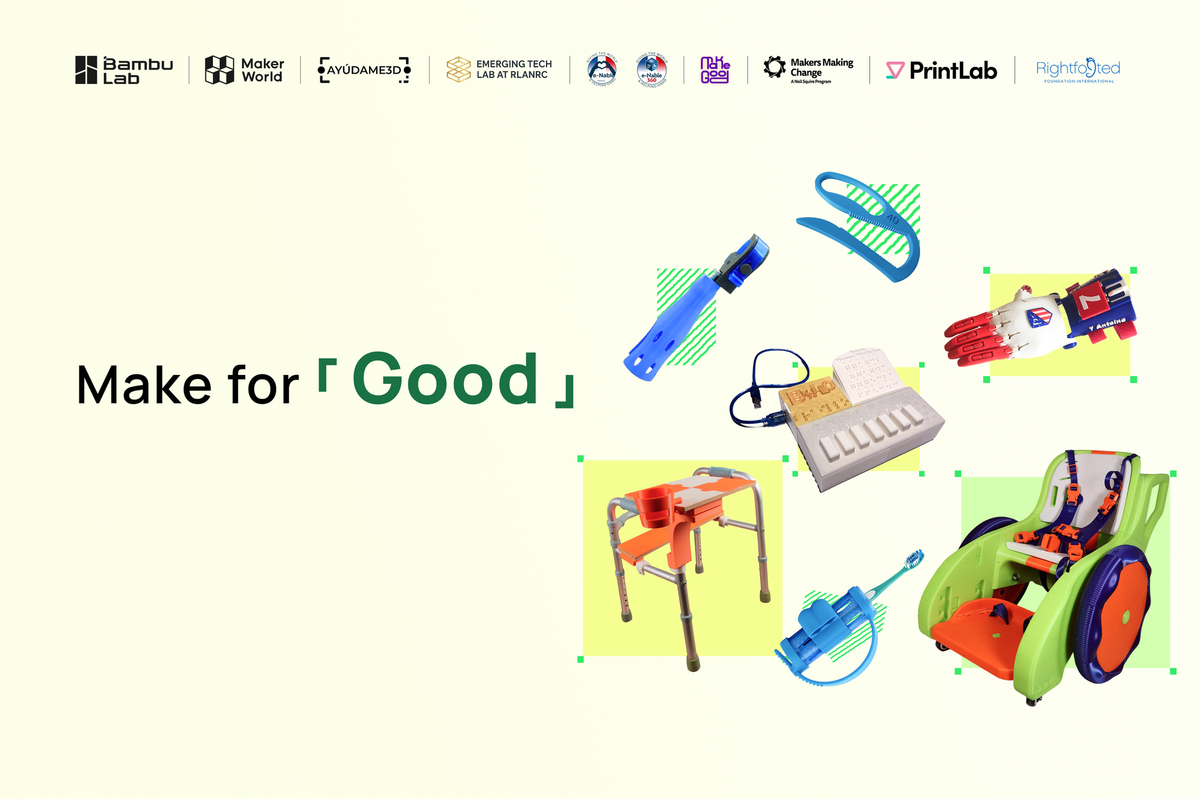
Twenty-four briefs and seven leading accessibility organizations from around the world. That is the scale of the global design challenge Bambu Lab is launching together with its partners on MakerWorld, the largest community of makers who design, share, download, and print 3D models.
From September through December 2026, that community will work on solutions for people with disabilities. The goal is tangible: objects someone can pick up and actually use.
This is the first time MakerWorld has mobilized its creator community to work for people with disabilities on specific, everyday needs. Each of the seven partner organizations owns a different part of the process, and that shared ownership is what makes this a genuine collaboration across the industry.
Seven roles, one process
Ayúdame3D, based in Spain, has designed and given away free Trésdesis arm prostheses since 2017. It will promote the challenge in Spain and send winning devices to communities around the world, including in Africa.
The Emerging Tech Lab at Rancho Los Amigos, in the United States, helps make sure designs reflect the lived experiences, interests, goals, and everyday environments of the people they are meant to support.
e-NABLE France will take the challenge to French-speaking makers. Its network of more than 450 volunteers has already fitted over 200 3D-printed hands.
MakeGood, in the United States, advises on briefs rooted in real user research. Since 2021 it has made free, custom assistive devices, among them the Toddler Mobility Trainer, a fully 3D-printed wheelchair for children.
Makers Making Change, a Neil Squire Society program in Canada, will promote the contest there. Winning designs will be considered for its open-source assistive technology library, so its network of volunteer makers can build them for people with disabilities. It has delivered more than 30,000 devices with help from about 40,000 volunteers.
Print Lab, in the United Kingdom, brings a human-centered design toolkit it has used in its assistive-technology challenge since 2020.
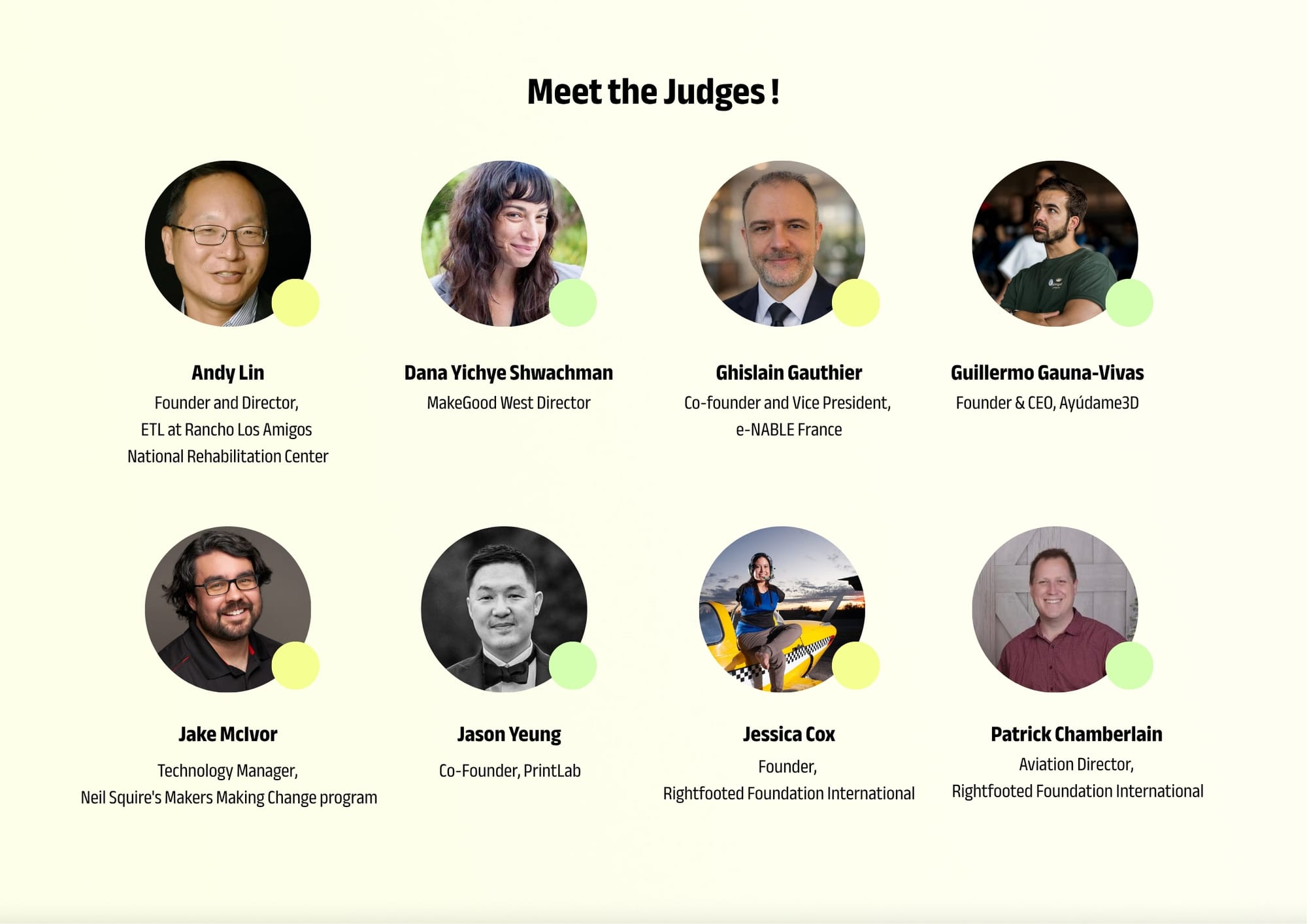
Rightfooted Foundation International, in the United States, is contributing briefs from the limb-difference community including work done with Jessica Cox, and will help get finished models to the people who need them.
Behind every brief is a real person
This is the core idea. Every brief describes a specific, present-day need, drawn from work with real users.
Jessica Cox, who founded Rightfooted Foundation International, was born without arms and uses her feet for daily life. She can pull on her first sock with a bare foot. The second sock is the problem: once one foot is covered, she loses the friction she needs to work fabric over her heel. Fastening a bike helmet still means sitting on the floor and lining up two small buckle halves by feel, one foot planted for balance.
At the Emerging Tech Lab at Rancho Los Amigos National Rehabilitation Center, it is often these small, everyday moments that spark an idea for a new solution. Working directly with people with disabilities and rehabilitation professionals, the ETL uses 3D printing and digital fabrication to develop and create practical tools tailored to individual needs.
For example, picking up an item from the floor can be difficult when a conventional reacher requires squeezing a handle to operate it. People who use wheelchairs may also have difficulty storing, accessing, and retrieving everyday items such as phones, wallets, purses, and keys. These everyday situations can inspire makers to create simple solutions that make a meaningful difference.
Other briefs live in the kitchen, the bathroom, and the things people do for pleasure.
Ayúdame3D is asking for a toothbrush that does not have to be pinched, a way to tie a ponytail with one hand.
E‑Nable France challenges makers to develop a one‑hand kitchen toolkit.
Makers Making Change is asking for a knitting-needle support for stroke survivors, a guitar pick that stays put with limited grip, and a marker-cap aid a teacher can manage alone.
Print Lab is asking for a tabletop game a child with cerebral palsy can play with friends, designed to look and feel like a real game.
MakeGood calls for a pickle‑ball paddle holder for users with weakened hand‑arm musculature who struggle to grip sports paddles and wish to play pickle‑ball alongside friends.
Those last two points run through everything. Accessibility should be built into the fun and the function, so the result looks and feels like something a person wants to use. The briefs steer away from the appearance of therapeutic equipment.
People should be able to set a thing up, use it, and put it away on their own, without asking for help at every step.
"These are not hypothetical users. Jessica already walks her dog. Someone in a ward at Rancho already drops something and has to ask a stranger to pick it up. The question for makers is very small and very specific: can you print the missing piece so that person does not have to ask?"
said Qianye, Creator Operation at MakerWorld.
The challenge is open to any disability, as long as the need is clearly described. Existing projects can be submitted too, if they are adapted to meet a specific brief and the changes are documented.
How it works
The MakerWorld community will have two months to submit their designs. The partner organizations then spend a month printing shortlisted models and testing them with the people named in the briefs. Then some partners will deliver those prints to real users, and the feedback will shape the final results.
MakerWorld is also adding Creator Achievement Badges to its make for good contests, recognition for eligible participants meant to strengthen their sense of participation and achievement and to reflect the social impact of what they make.
Winning files will be added to open libraries and distributed through volunteer networks that already deliver devices in more than 70 countries.
The challenge launches in September and wraps up in December.
Bambu Lab and MakerWorld supply the platform and the community. Hardware stopped being the main barrier years ago, once accessible printers brought the cost and difficulty of 3D printing down, and MakerWorld grew into the largest community of makers.
Our partners have long built structured pathways connecting creators with people with disabilities. What MakerWorld delivers is creativity at scale: it unlocks richer creative ideas from more diverse backgrounds and draws more skilled creators into assistive design. This makes more makers aware of how they can contribute toward good, deepens understanding of the barriers people with disabilities face, and fosters greater empathy across the community.
The success of the challenge will come down to one moment: someone who once set a game aside because they could not handle the pieces sits down and plays it on their own.