Koobz story - scaling on-demand footwear manufacturing through 3D printing
By pairing scalable 3D printing with a fully digital manufacturing workflow, Koobz is demonstrating how footwear production can move faster, stay closer to home, and adapt to demand without the constraints of traditional tooling



For most of the past half-century, making a shoe has meant committing to a factory floor on the other side of the world. A single design must survive a gauntlet of steel molds, custom tooling, and minimum order quantities measured in the thousands before it ever reaches a customer's foot.
The process is slow, often a year or more from sketch to shelf, and unforgiving.
Guess wrong about demand, and a brand is left holding pallets of unsold inventory; guess right, and it may still wait months for the next production run.
For decades, this was simply the cost of doing business in an industry built on long lead times, offshore labor, and the heavy machinery of mass production.
But the logic that made all of this necessary is beginning to crack. Advances in industrial 3D printing, flexible materials, and software-driven workflows are opening a path to something the footwear world has rarely enjoyed: the ability to manufacture on demand, close to the customer, without betting the warehouse on a forecast.
The question is no longer whether digital manufacturing can produce a wearable shoe, but whether it can do so reliably, affordably, and at the scale a real brand requires.
One young company has set out to prove that footwear can be designed, produced, and sold in days rather than seasons. And it can happen on American soil, at a price that competes with overseas factories.
Its bet hinges on an unlikely foundation: not a proprietary industrial behemoth, but a fleet of fast, dependable printers humming around the clock.
Koobz
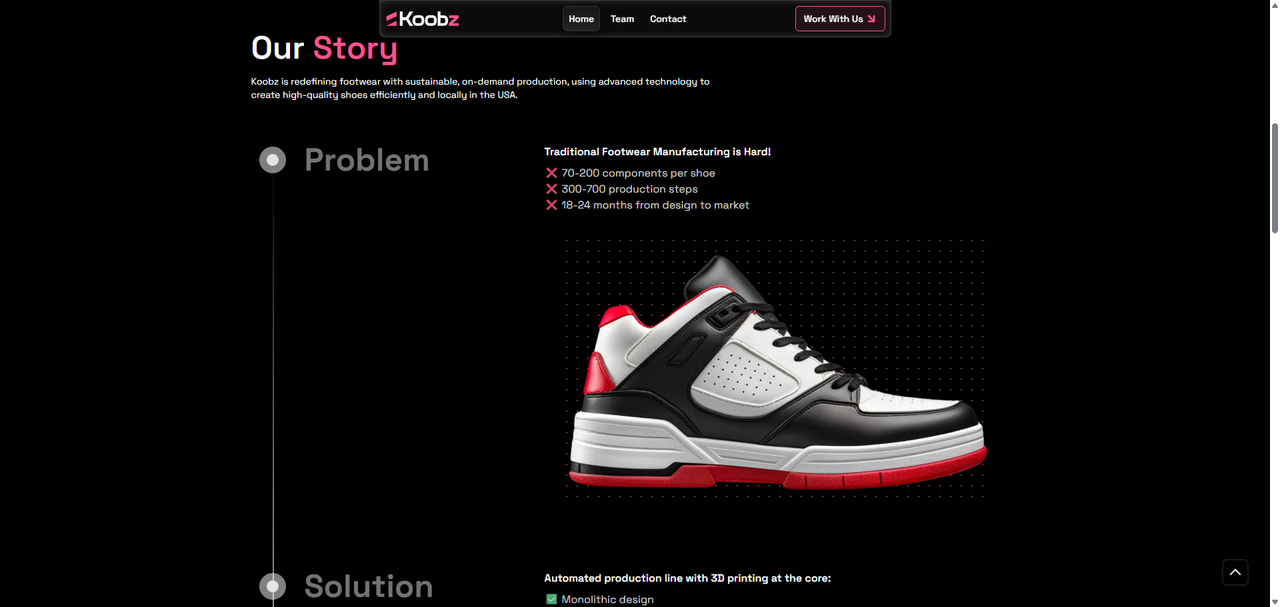
Koobz is a U.S.-based, on-demand footwear manufacturer that is redefining how shoes are designed, produced, and brought to market.
Positioned as a "Shopify for shoes" the company provides brands, creators, and influencers with an integrated digital platform that combines design, manufacturing, and logistics.
By relying on large-scale 3D printing instead of traditional molds, tooling, and inventory, Koobz enables footwear concepts to move from idea to sale in a matter of days.
Following a $7.2 million seed funding round, the company has expanded from a garage operation into a 10,000-square-foot factory in Ventura, California, laying the foundation for a highly automated, domestic manufacturing model.
Challenges Before Using Bambu Lab
Before standardizing on Bambu Lab printers, Koobz faced a structural dilemma common to advanced manufacturing startups. Industrial-grade additive manufacturing systems offered the reliability required for continuous production, but their cost and long deployment cycles made rapid scaling impractical.
At the other end of the spectrum, consumer-level printers were affordable but could not consistently support 24/7 operation at the quality and uptime required for commercial footwear production.
This imbalance constrained Koobz's ability to keep pace with growing demand for its model.
Scaling production meant either accepting high capital expenditure or risking reliability issues that could disrupt delivery timelines.
For a business built around speed, flexibility, and local manufacturing, neither option was viable.
Bambu Lab Solution
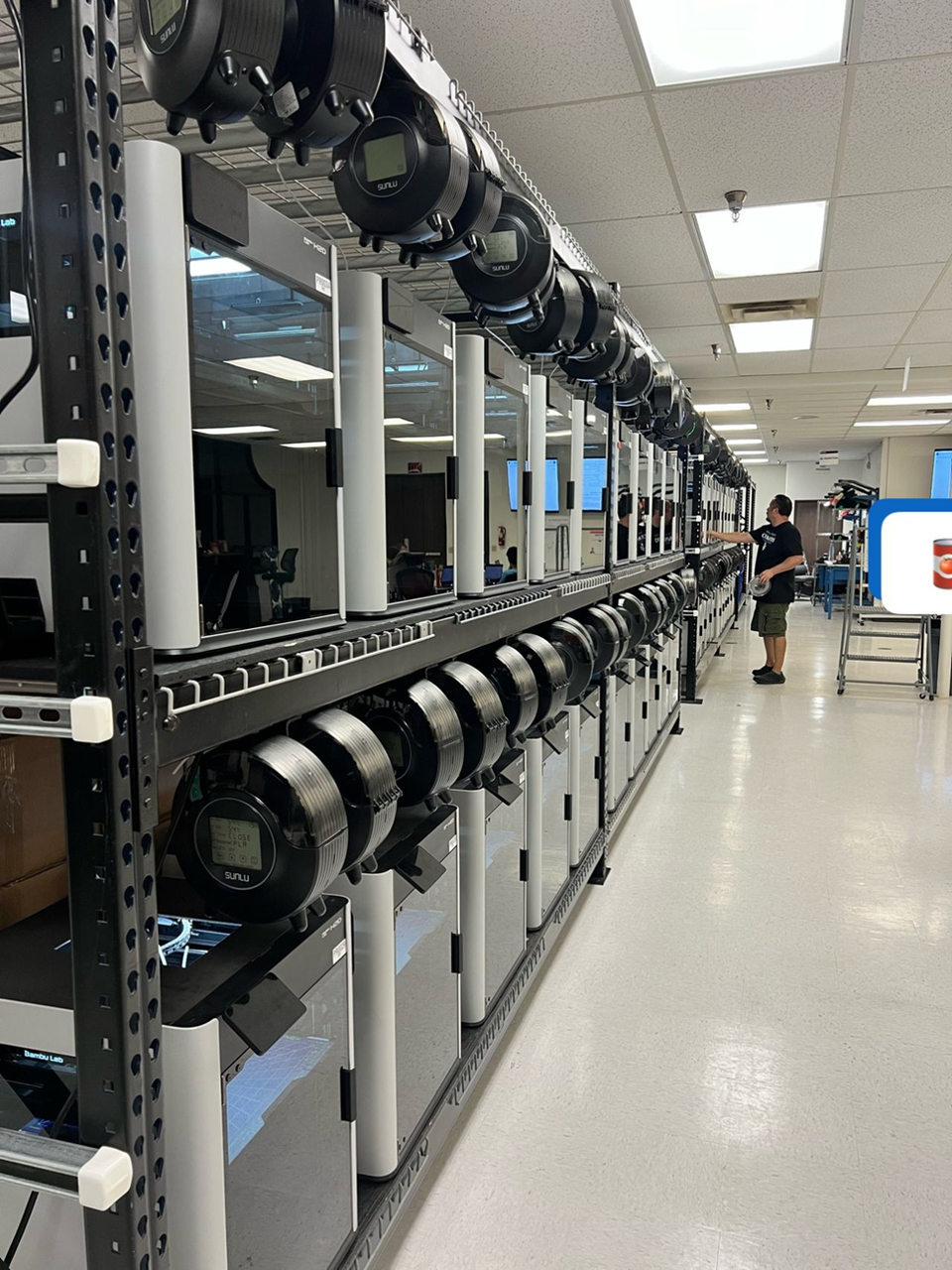
Koobz adopted a large fleet of Bambu Lab printers, primarily from the H2D series, as the core of its production infrastructure. The decision was driven by the printers' combination of speed, reliability, and print quality straight out of the box.
Unlike traditional industrial systems, Bambu Lab hardware allowed Koobz to add capacity quickly and incrementally, simply by deploying additional units into its print farm.
This plug-and-play approach aligned closely with Koobz's digital manufacturing philosophy. The printers support continuous operation and handle recyclable thermoplastic polyurethane (TPU), the flexible, durable material Koobz uses for its fully 3D-printed footwear.
While the company relies on its own proprietary slicer - developed specifically for footwear geometry and TPU behavior - the stability and consistency of Bambu Lab hardware provided a dependable foundation on which this software innovation could scale.
Results
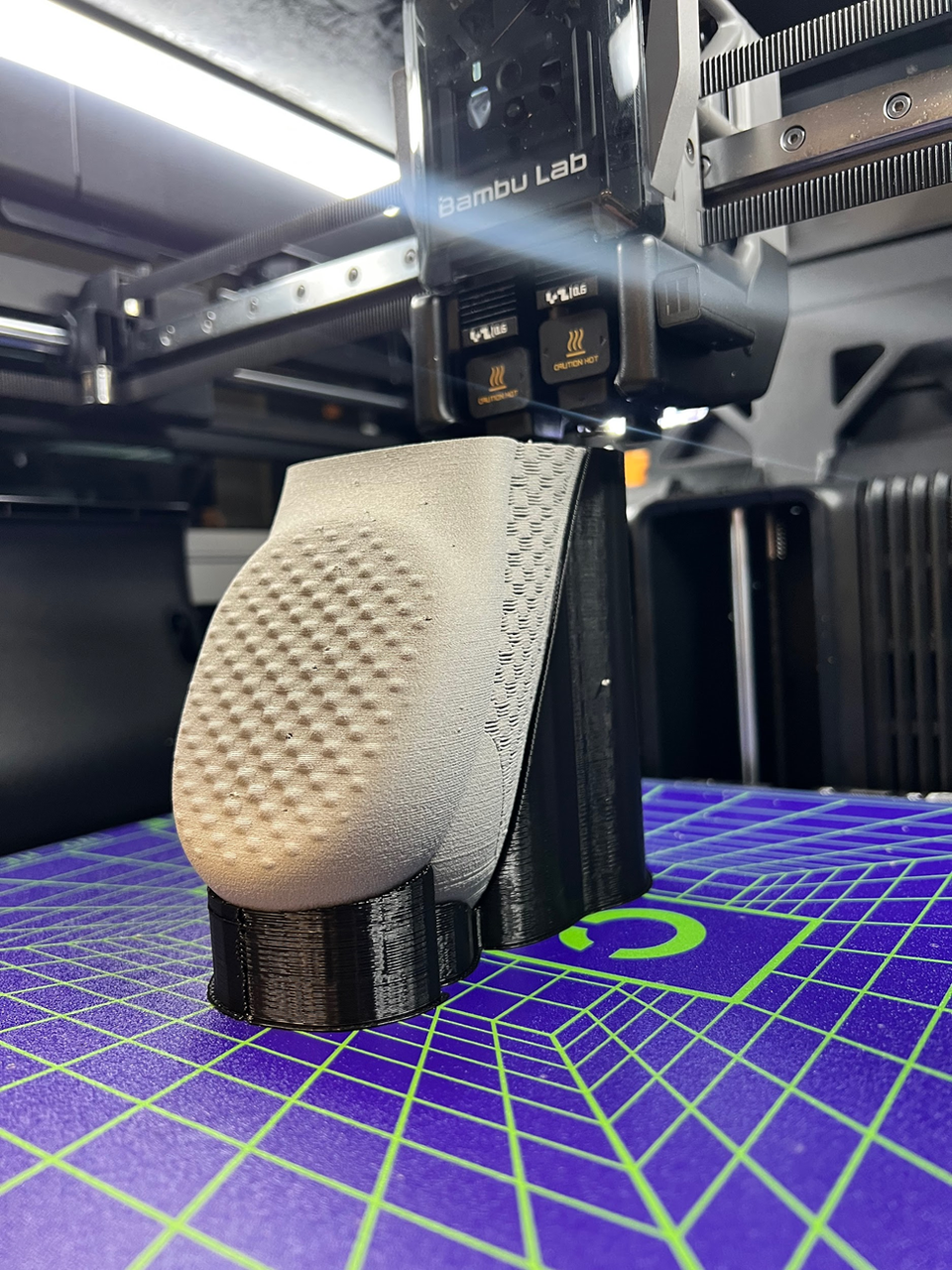
Adopting Bambu Lab printers has been central to Koobz's growth. The company has already expanded from an early fleet of around 50 printers to roughly 100, with plans to exceed 500 units by the end of 2026 and a long-term roadmap reaching several thousand machines.
This linear scaling model supports a target output of more than 200,000 pairs of shoes annually in the near term.
Time-to-market has been reduced dramatically. What traditionally required up to 18 months of development can now be achieved in days, enabling rapid iteration and true on-demand production.
Cost structures have also shifted. By avoiding tooling and leveraging affordable, high-performance printers, Koobz can manufacture footwear in the United States at costs that compete with overseas production, while reducing supply-chain risk and carbon emissions.
Looking Ahead
Koobz plans to continue expanding its print farm while integrating more robotics and AI-driven automation across harvesting and post-processing. The long-term vision is a highly autonomous "dark factory" capable of producing between two and four million pairs of shoes per year.
At the same time, the company is advancing its intellectual property around footwear-specific slicing and digital workflows, with multiple patent applications underway and public presentations planned within the footwear industry.
As production scales, Koobz is also exploring deeper integration between its manufacturing execution systems and printer fleets, signaling a future where hardware, software, and logistics operate as a single, tightly connected system.
Conclusion
For Koobz, Bambu Lab printers have served as a practical bridge between experimental innovation and industrial-scale manufacturing. By delivering reliability and speed without prohibitive cost, the hardware has enabled the company to turn its vision of localized, on-demand footwear production into an operational reality.
The result is not only faster development cycles and competitive economics, but also a new model for how footwear can be designed and manufactured in the United States.